“I noticed we did a lot to support the patients but there’s not a whole lot of specific support in place for family caregivers. When someone is discharged from a facility they can meet with up to 6 people. Like physical therapy, occupational therapy, speech, nursing, or psychiatry. I was one of those clinicians handing discharge information to people who were already overwhelmed. And they would look at me like a deer in headlights,” said Dr. Ashley Blackington, Entrepreneur, Board Certified Occupational Therapist and Caregiver Advocate.
Many of us feel dropped into the swirl of family caregiving, without the expertise, we desperately want. And caring for adults is a different game than caring for kids. Whether it’s your parents or a spouse, their level of receptivity to your involvement in the care plan, depends on a lot. Including that person’s style, your relationship and their health needs.
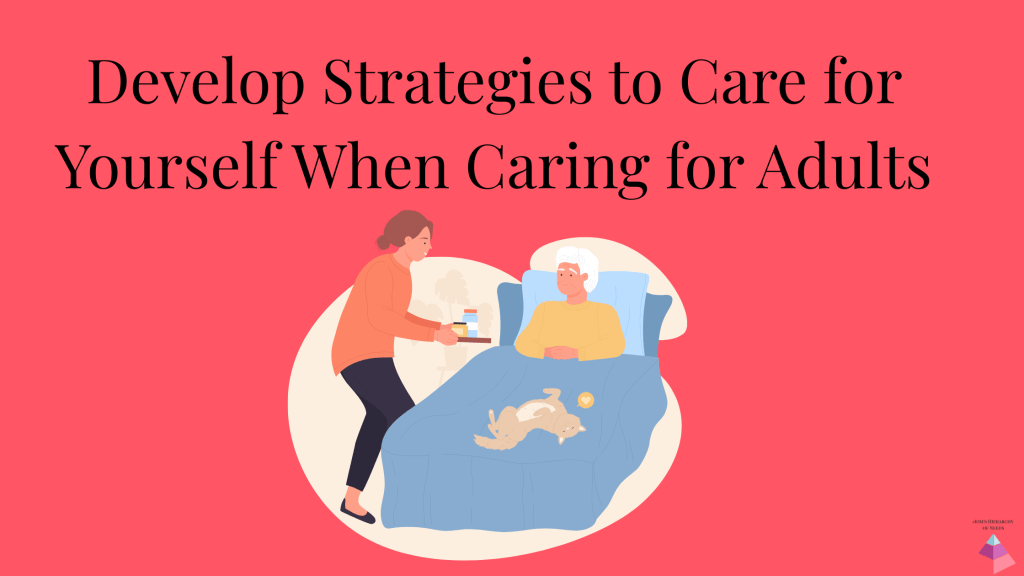
Caregiver burnout is a real challenge and family caregivers are already at high risk. That risk only skyrockets when parenting is combined with caring for adults. In part, because self-care is often abandoned. However, you can begin to incorporate your needs in parallel with caring your loved ones.
Family Caregiving is On the Rise
A lot of us are familiar with high demand caregiving. Responsibilities that make us feel like we need medical training to do them well. Millions of children have complex medical needs and the number of people caring for adults is on the rise.
Many of us are called into service when aging parents, partners or siblings with serious medical conditions or disabilities, need support. And according to AARP’s latest caregiving in the US report 63 million people are caring for adults with nearly one third (29%) parenting at the same time.
Health Changes Can Happen Quickly
Ashley explained, “Things can happen really quickly tied to a new diagnosis and level of function. For both the family caregivers and the patients themselves.”
She began her career working in hospitals. She explained the average stay was around 2 weeks. “It’s not a lot of time specially if someone was in acute care for a while. Then, all of a sudden, they have to make modifications at home, if that person is going home. So much of that process in hospitals focuses on the patient, as it should. However, that person doesn’t exist in a vacuum. They often have people around them.”
It Means Navigating your Involvement
When caring for adults, you need that person to opt in to the process and your involvement, which is generally not the case with our children.We covered the challenges of the logistics in part one from our interview. Ashley said, “if it’s really clear that they need the help and can’t just sail on out of the hospital or the facility on their own accord they do need caregiving.”
When Ashley left the hospital and started her private practice for proactive aging in place, she often facilitated conversations between adults and their aging parents. “The likelihood is that if you move into caregiving for older adults, it’s during the time in your life when you probably have kids at home. And they may be young kids and you go into what is known as the, sandwich generation.” Aptly describing the squeeze of managing both responsibilities.
And Planning Your Own Preventative Care
Ashley and I discussed the challenge of self-care, which is already significant for most mothers and becomes herculean when also caring for adults. Ashley said, “Family caregivers put off or don’t go for their yearly blood work or to the dentist. And I always frame the need as ‘an ounce of prevention is worth a pound of cure.’ Although it sounds very preachy, because most people will say, ‘I just don’t have time to do that.’ And I’ll respond, you have to make the time to go for your mammogram, colonoscopy or the dentist.”
Line up Respite Coverage
If your loved one needs help with the activities of daily living like bathing or eating versus companionship or medication management, the skill sets are different to hire paid caregivers. However, as challenging as it is to find childcare, finding adult or senior care is that much harder and typically more expensive. So, consider options within your local network for short term coverage and support. In addition to whatever long-term care planning your family may need.
Ashley said, “that might be the one time where you say to June from down the street, ‘can you come and hang out with my mom for an hour so I can go to this appointment?’ Or ask yourself, ‘how can I make this fit onto my schedule?’ We schedule what we prioritize. Like our parents’ doctor’s appointments, therapy, rehab, our paid work and stuff for our kids. If you are the one holding the pen and don’t write it on the calendar, it’s not going to happen.”
And Get Intentional with Self-Care
The health stats for family caregivers aren’t good. Because of the stress, lack of support or self-care. So, it’s critical to stay attuned to your own needs at any given point and build in something for your wellbeing. Ashley said, “As caregivers if you keep carving out from yourself there’s nothing left and then you run the risk of being in a worse off situation. So, think of doing the best that you can to keep yourself healthy so that you can continue to be in all of these roles in your life that you want to be a part of.”
Personalize Strategies that Fit Your Life
When I asked Ashley, how she defines self-care and what it looks like in her life she said, “I think self-care is protecting your time. And whatever you choose to do with that time, is totally up to you. When I had new babies, self-care was sitting in my bedroom closet for 5 minutes at 4:00 when everyone was losing their mind. I wasn’t going to go get my nails done, when what I actually needed was for my central nervous system to stop feeling like it was a wildfire.” Amen.
She added, “Self-care is really listening to yourself and choosing to walk away from things. Self-care right now looks like cleaning off my desk because when I look at clutter I can’t focus on the work I need to do. Sometimes, it’s taking the dog for a walk because I have been staring at this blinking screen forever and ever. It’s saying on Sundays I do not open my e-mail. And on Friday nights, we have pizza and movie night with the kids and I’m fully present for that. I can’t be fully present for everything and it’s also recognizing that and being really honest about it, especially with my kids by saying, I would really like to but I can’t right now.”
Many thanks to the talented Dr. Ashley Blackington!
Learn more about her company’s new app to support family caregiving on the website, Facebook and Instagram. Follow her show the And/Both podcast and her great adventures on Instagram, Pinterest and, LinkedIn.
——-
📚 Order the book, Repair with Self-Care: Your Guide to the Mom’s Hierarchy of Needs.
 Enjoy the gift of more time for you. Self-care support, app & packages for Moms.
 Ready to put yourself back onto your to-do list? Take a TimeCheck.
 Shared your story yet? Take our quick survey to change how workplaces support parents.
 Employers, ready to rewrite hidden workplace rules? Become Allies@Work?
About Ashley:
Dr. Ashley Blackington is a board-certified Occupational Therapist, founder of Dovetail®, creator of Home Field Advantage and host of the AND/BOTH podcast, all layering together to create a multi-platform ecosystem designed to support the people doing the hardest job of all: caregiving.
After more than 14 years working in hospitals, homes, and care systems, and living the realities of caregiving herself, Ashley saw firsthand the emotional, logistical, and systemic weight family caregivers carry. She built Dovetail to address those needs directly: a CareTech platform that helps families organize care, communicate clearly, and build sustainable support networks.
Through Home Field Advantage, she offers virtual consulting and group coaching for caregivers and the workplaces that employ them. And through AND/BOTH, she holds space for the often-unspoken emotional truths of caregiving life.
Together, these projects form a new kind of care infrastructure- one that centers on the caregiver, honors the complexity of their journey, and meets them with clarity, compassion, and tools that truly help.