“I was so busy selflessly being in charge and handling everything, I didn’t have to feel guilty. I had I built a guilt-proof-world for myself that was not sustainable. If you’re already doing the maximum for everybody around you, when you stop doing that and say, ‘I’m not going to be able to host Thanksgiving this year.’ Or ‘no I can’t join that committee.’ Then you feel that guilt,” said Amy Wilson, Author, Podcast Host and Speaker.
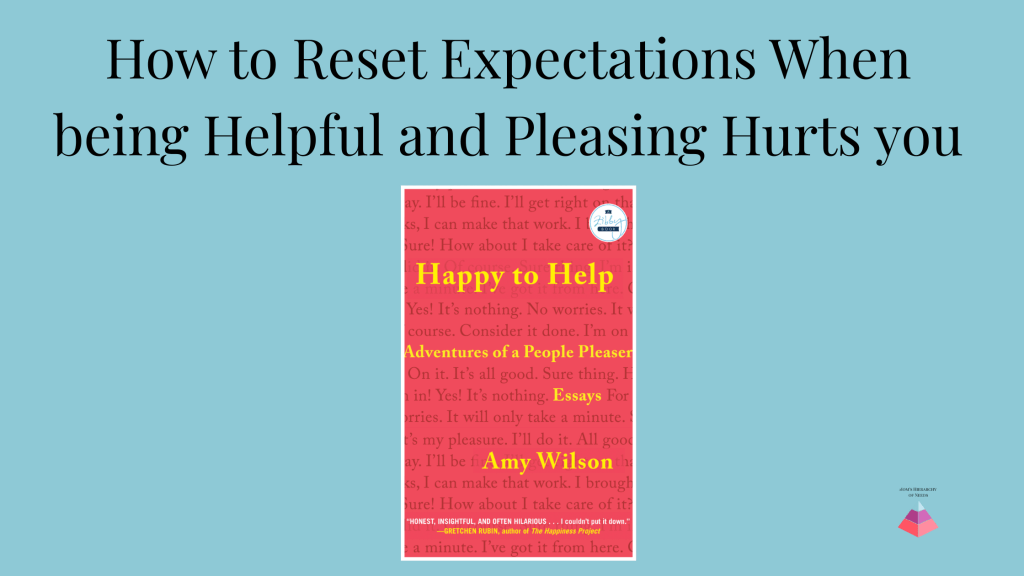
There are so many intricacies to how women are socialized. As mothers, it’s not only about pleasing people for ourselves, we’re also called to manage expectations on behalf of our kids. But as Amy shares in her new book, Happy to Help, we don’t have to play along when it’s hurting us. You can reexamine everything. Including how much ‘being helpful’ costs you.
People Pleasing is Part of Our Culture
There’s a continuum of “people pleasing” behaviors often to avoid discomfort. Even when it’s not in our best interests. And according to last year’s You.gov survey, “Women (52%) are more likely than men (44%) to say they would describe themselves as a people-pleaser.” However, most (93%) respondents said they engaged in at least one form of ‘people pleasing’ behavior ‘somewhat’ or ‘very often.’ Overriding such an entrenched and celebrated cultural norm, isn’t easy to do for anyone yet women tend to be penalized for it.
How do you Really Feel About Helping?
Amy said, “I am the oldest daughter and granddaughter in big Irish Catholic family so, I was supposed to ‘do and do’ and I was good at it. I was also supposed to be happy about it.”
It’s exhilarating to be of service and it’s how many of us are trained to show love and commitment. So it’s not surprising we don’t question it. She added, “As a fifth grader babysitting for free I wasn’t thinking, ‘someday I’m going to turn the tables!’ There was no resentment underneath any of it. In fact I never stopped to think about it at all.”
It Can Quickly Become Too Much
Moms are still on point for all things childcare and household, in most families. And we discussed how that ‘helping’ vibe can break us. Amy said, “All of us will come to a breaking point and it might be a crisis at work, or the preschool auction or in my case, having a kid with a chronic illness. And then I also got sick myself.”
She explains in the book navigating the complex medical system to find answers when her oldest child faced a serious illness. It was a long, emotional process that forced ruthless prioritization. The conditions in our lives are dynamic so, how do you enlist support when you can’t do what everyone expects?
And Family May not Step In
When Amy was overwhelmed, she didn’t get the response she expected. She explained, “It was in the pandemic, and I really felt like I was going to crack. And then when I went to people I loved to say, ‘I’m not doing so good. I need some help,’ what I tended to get back in that situation was some version of, ‘stop making things so perfect.’ Or ‘why did you feel like this was yours to do in the first place?’ There’s a lot of emotional homework to untangle that.” Where do you begin?
You Can Change Your Priorities
As a long-time, self-described “people pleaser” Amy decided to tackle this critical topic in a series of thoughtful and funny essays for her newest book, Happy to Help. She said, “do some of us take on more than we can handle? Yes, I’m guilty of that for sure. But when your kid is chronically ill, ‘there you go again with your too high standards’ doesn’t apply.”
It’s difficult for moms to set boundaries for many reasons. There are gendered norms about what it means to be a ‘mom’ but our backgrounds, family experiences, and contexts are in the mix too. So how do we retire the Superwoman capes when over performance no longer fits?
Examine Your Role in the Challenge
Amy said, “If you are capable and responsible when you say, ‘I can’t take it anymore’ people around you are baffled. They didn’t know you were suffering because you were striving so mightily to seem like you weren’t.”
We discussed how nuanced it can be to unwind patterns that don’t serve us. Especially when people in our lives expect them. She added, “If they couldn’t read your mind, that doesn’t make them bad people. Often, we do participate in this.”
Navigate New Boundaries when Needed
Amy said, “When I started to set boundaries, it felt like I shouldn’t be able to say, ‘no I’m not going to do that.’ But it’s okay to rest before everything’s done. And to say no because you don’t want to, not because you actually can’t. I’m still learning how to not feel guilty about that.”
It’s easier to be vulnerable when you’re out of capacity but why wait until burnout hits? It’s okay to override other people’s goals for our time. Start conversations with your partner, if partnered or other family members, including kids when it’s age appropriate. She added, “You’re probably going to get some form of resistance at first but keep going. Instead of thinking, ‘I knew they wouldn’t run this summer carnival without me’ don’t give up too soon.”
And Seek Solutions that Ease your Workload
Amy wrote the book in her signature witty style to bring levity and accessible insight to challenges “helpers” face. She said, “When your circumstances are overwhelming, they’re hard because they’re hard. Not because there’s something wrong with you. You don’t have to become less of a workaholic or less of a people pleaser to change things in your life that are really grinding your gears on a daily basis.” Amen!
She explained we’re socialized to beat ourselves up when life isn’t perfect. But we can find those opportunities for action over self-recrimination. “The change you seek is often practical, not emotional. I think the more time spent reading books on ‘how not to be codependent’ is less time fixing the problem, which is that you need a babysitter twice a week.”
Many thanks to the talented Amy Wilson!
Buy Amy’s delightful new book, Happy to Help. Adventures of a People Pleaser. Subscribe to her podcast, What Fresh Hell and follow her great adventure on her website, LinkedIn, Facebook, and Instagram,
——-
📚 Buy the new book, Repair with Self-Care: Your Guide to the Mom’s Hierarchy of Needs.
 Enjoy the gift of more time for wellbeing and growth. Plus delightful self-care packages for Moms, delivered to your door.
 Ready to put yourself back onto your to-do list? Take a TimeCheck.
 Shared your story yet? Take our quick survey to change how workplaces support parents.
 Employers, become Allies@Work
About Amy Wilson:
Amy Wilson is the author of two collections of essays: Happy To Help (Zibby Publishing) and When Did I Get Like This? (Harper Collins). When Did I Get Like This? was an “Emerging Author” pick at Target, the recipient of a Mom’s Choice Gold Award, and was optioned for a TV series by Lionsgate.
Amy is also the co-host of What Fresh Hell: Laughing in the Face of Motherhood, a Webby-honored podcast, along with Margaret Ables. “What Fresh Hell” has over 800 episodes, 10 million lifetime downloads, and a dedicated audience.
Amy is also an actor who has appeared on Broadway, as a series regular on multiple sitcoms, and in dozens of other TV shows and films. She acted in and produced Julie Kramer’s The Best of Everything, an adaptation of Rona Jaffe’s novel that became a New York Times Critic’s Pick.
Amy was also the performer and creator of Mother Load, a solo show which toured to sixteen cities nationwide after its hit off-Broadway run. Amy has also performed her comedy at the HBO US Comedy Arts Festival in Aspen, and in Saturday Night Live’s famed Studio 8H.
For six years Amy was the director of the New York City version of Listen to Your Mother, a national series of live readings in celebration of Mother’s Day that became a grassroots phenomenon.
Amy is a proud native of Scranton, PA, and lives with her family in New York City.