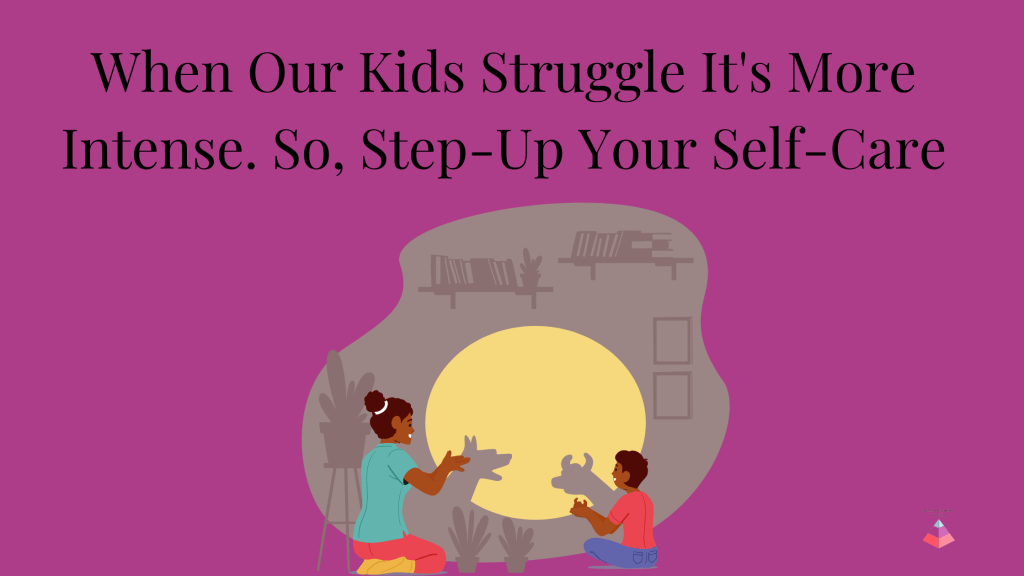
“If you feel overwhelmed, like your heart is racing and your mind is keeping you up with all of these thoughts, that’s the time to really pay attention to what you need. Because you can’t make good decisions, control your own emotions, or respond to your child or family’s needs, if you are spiraling,” said Dr. Karen Wilson, Pediatric Neuropsychologist and Entrepreneur.
We tend to get really great, at handling stressful situations. Especially with our kids. A certain level of mom-calm descends when the tantrum starts, fever spikes or college application is denied. So, we get tons of practice with high stakes, creative maneuvers. But our bodies are not set up to absorb the impact of chronic stress. So, how do you restore wellbeing, when your stress levels are up, and your kids need more support?
Our Children’s Needs Can Intensify
Karen works with children who have anxiety, depression, ADHD, autism spectrum disorder or dyslexia. And the process, to find the right mental health diagnosis, doctors or school support for neurodiverse kids, can be fraught. It’s further complicated by the shortage of pediatric mental health providers. Sometimes, it takes nearly a year for an appointment, depending on what’s required and where you live.
And often, that’s only the beginning of a multi-year process. She added, “When you have a child who is struggling there’s no guidebook on what to do to figure things out. Or when to seek outside help. Like when to talk to their teachers about getting more support or what conversations to have with your pediatrician.”
So, Follow Your Intuition
Karen said, “I have too many families coming in and saying, ‘I wish I’d known about this sooner and paid attention to what my intuition was telling me about my child.’ We often see changes in our children before anyone else. She explained, “They often wait, because a teacher said, ‘oh he’s fine,’ or ‘she’s shy,’ or ‘they’ll just grow out of it.’ Then years go by, and their child is depressed, anxious and has a low self-concept and they wish they intervened sooner.” But it’s never too late to find support for your children or yourself.
And Prepare for A Journey
Don’t go down the ‘how did I miss this’ road, because everyone is beyond busy trying to keep their lives afloat. Karen said, “So, my mission is to help educate more parents on the broad spectrum of what we call neurodiversity. Which are just differences in the ways our brains are wired and how that impacts our ability to learn or to navigate social relationships.” Critical work that improves lives for kids and adults. She added, “Everything stops to make sure that our child’s needs are met. And we know Moms are the primary caregivers over 80% of the time in families. So, the mom guilt is real.”
That Often Intersects With Your Career
Karen explained, “If you’re working, then burnout becomes exacerbated because you’re trying to manage being seen as competent. And you might be trying to advance in your career, when you also have all of these childcare responsibilities. If your child has unique needs, and you don’t understand some of those needs, it takes a whole other level of effort and time to do your research, keep up with appointments and figure out what’s going on. It can be really hard journey.” So, what happens when you’re on a path that can feel excruciatingly slow?
And Can Ramp Up Stress for Your Family
Karen said, “It’s so important is to make sure that Moms give themselves time to manage their stress. Because what we know about Mom stress, is that it’s directly related to child stress.”
Why yes, studies show, whether you have toddlers or teens, your levels of the stress hormone, cortisol, impacts your kids. And it works in the other direction as well. For many reasons, stress and anxiety tend to ripple through families. She added, “If parents can manage their own stress, you indirectly also help to buffer and manage your child’s stress. And there are a number of ways to do that.”
So, Revisit Your Self-Care Routines
As you navigate what’s next for your children, include yourself in the equation. Because it doesn’t help anyone if you’re not healthy and whole. Karen said, “I can’t do anything well if I’m not taking care of myself. That being said, I don’t do all the things that I need to do, right? I don’t exercise or meditate every day, but I do prioritize sleep. That’s the one thing that I won’t take any shortcuts on.”
Protect Your Sleep
Karen said, “We can all do everything better with a good night’s sleep. Because it impacts cognition, decision making, emotional regulation, immune system functioning and your memory. So, I have to start there, and try to get the other things in, when I can.”
Self-care is vital. Yet, in our research study of post-pandemic conditions, 79% of Moms in our current wave cite doing, ‘terribly’ or ‘not as well as usual’ at self-care. And the reality is, there are so many barriers to make the time, it’s rare to be consistent with everything on your preventative health list. So, choose wisely where you can get the most relief. Sleep is key. But as many of us experience, if you’re pregnant, postpartum or going through perimenopause, hormonal change can disrupt sleep. So, what else can you prioritize?
And Know When You Need More
Karen advises paying close attention to when you need more than a good night’s sleep. She explained, “For example, I know when I need sleep plus mindfulness, or sleep plus a walk around the block. So, that comes back to following your intuition and knowing what it is that you need. We need exercise, good nutrition, good sleep and yes, mindfulness is right there too. But we may not be doing them all at the same time or at the levels we need to.”
Add Restorative Activities to Your Calendar
Of course, the ‘top of the Mom’s hierarchy of needs’ activities, that fuel mental, physical and emotional health are elusive when you’re on point for most childcare, and have to run your home like a 4-star general. But, consider cutting back on everything that’s less urgent. Revisit roles with your partner, if you are partnered, and outsource where you can afford to. Or better still, eliminate what can be deferred, to free up space. At any given time, you will need to revisit priorities and move things around, to give yourself the gift of more time and energy.
Honor Your Body’s Messages
Karen said, “It’s a balancing act. Knowing when you need to increase your exercise, your mindfulness, or when to make sure you’re getting adequate sleep. Keep that in mind and stay in tune with your own body and needs.”
All of this requires time, the resource we tend to lack. But despite how common it is for Moms to ignore our wellbeing; we quickly reach a point where self-sacrifice undermines our priorities. Including how we parent.
Tireless efforts to serve others can become joyless and exhausting. So, request support and renegotiate with every adult in your life, about what you are willing to do. So, you can streamline your focus and workload as much as possible. If that’s not sufficient, consider mental health support, like therapy, asking your primary care doctor for guidance or a more significant break, such as taking a family medical leave, from your employer,
Many thanks to the talented Dr. Karen Wilson!
Learn more about her work on her website, and check out her insightful podcast, Different Thinking, Different Learning. And follow her great adventure on LinkedIn, Facebook, and Instagram,
——-
 Enjoy the gift of more time for wellbeing and growth. Plus delightful self-care packages for Moms, delivered to your door.
 Ready to put yourself back onto your to-do list? Take a TimeCheck.
 Shared your story yet? Take our quick survey to change how workplaces support parents.
 Employers, become Allies@Work
About Dr. Karen Wilson:
Dr. Wilson is a Clinical Neuropsychologist and the Director of West LA Neuropsychology, PC. She specializes in the assessment of neurodevelopmental disorders in children and adolescents, and has extensive experience evaluating children, adolescents and young adults who present with learning, processing, or social-emotional challenges. As a clinician, her goal is to use her in-depth understanding of brain-behavior relationships to help identify the causes of difficulties individuals are experiencing, and she utilizes comprehensive and evidence-based approaches to determine one’s unique neurocognitive profile, which includes the identification of strengths and weaknesses, in order to help her develop a treatment plan tailored to each child, adolescent or young adult.
She is also the founder of ChildNEXUS, an all-inclusive education and mental healthcare service industry marketplace. ChildNEXUS connects parents whose children struggle with learning or social-emotional challenges with professionals who provide psychological, medical, legal, and educational support services. In addition to supporting families, we provide the professionals in our community with workshops, virtual roundtables, meetups, and collaboration opportunities.