“You can grow up with the same parents yet have completely different childhood experiences than your siblings. So, how can we possibly assume two people at the same workplace, even if they’re in the same role, can’t have very different experiences? Acknowledging what you see, feel and experience at work may not be what someone else experiences, sees and feels at work, is what DEI is all about.” Said Su Joun, Author, Entrepreneur, Diversity and Inclusion Expert.
Whether you run a business, team, client group or projects, you need to build strong connections with others to grow. However, most workers are burned out, or disengaged, which places a premium on building trust. No one believes promises over performance anymore and your intentions need to be aligned with what you do.
Although we’ve heard a lot about empathetic leadership, especially post pandemic, the reality is people always need to feel seen. It’s not specific to a role, industry or era, it’s just part of how humans function best. So, how can you build strong relationships with more people, including those from different backgrounds?
Inclusivity is Thoughtful
Diversity, Equity and Inclusion (DEI) has become a hot potato topic many are afraid to discuss, especially in the US. However, underneath the terminology are principles most of us value.
Su said, “I believe certain ideology within DEI is under attack, and I believe there are misconceptions that are under attack. And frankly there are things that didn’t work, that rightfully should be under attack and I want to separate those things. Because it’s not all the same and we shouldn’t lump them together.”
But it Can be Misconstrued
Su explained, “Some people call it diversity, equity, inclusion and belonging, accessibility or equality. I’m not as concerned about what we’re calling it, let’s describe what DEI work really is. At its core, especially in workplaces, it’s not about putting someone at the front of the line because of their identity. It’s about removing barriers that may be preventing people, because of their identity, from getting in line and frankly staying in line.”
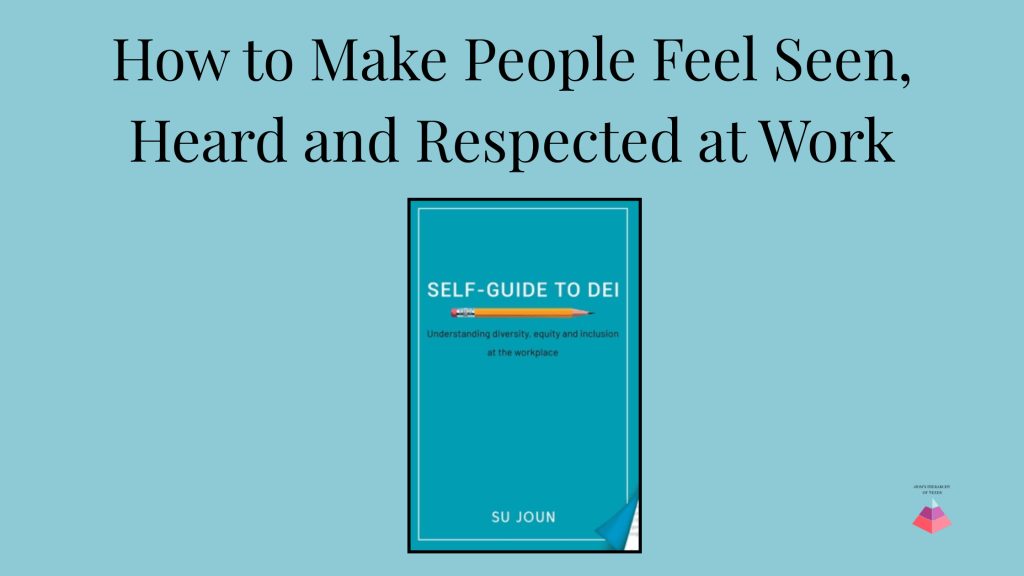
Although most workers relied on their employers to teach these principles, many organizations have cut or scaled back DEI programs. Yet, the skills are an essential part of your leadership and career development toolkit, whether you manage people or not. Su’s book, “Self-Guide to DEI” is a short, interactive series of exercises to help people untangle their beliefs, unconscious behaviors and values, to advance aligned actions at work.
Build Psychological Safety with ‘Yes, And’
Su said we can start with language. “In a group meeting or one-on-one, when someone is done talking if you can say ‘yes and’ unless the meeting is specifically to make a decision. Ninety-nine percent of the time, it makes the conversation more inclusive.”
She added, “We often say, ‘yes but’ or ‘no however,’ and that can imply some kind of conflict that makes people hesitate. ‘Yes and’ means ‘yes, I heard you and I’d like to add.’ It allows you to subtly practice creating psychological safety.”
Amplify your Colleagues
Su said, “Another thing you can do is to amplify someone. If someone said something that was ignored, speak up. For example, ‘Leslie can you say that again?’ to make sure Leslie has been heard and acknowledged. When what’s said is dismissed or not acknowledged, it diminishes people. You can amplify someone in the workplace regardless of your role and frankly, without much risk. No one’s going to say, ‘I can’t believe Su amplified Leslie’ right?”
Pay Attention to Personal Details
We’ve all been told to grow our professional networks, it’s critical internally and externally. However, be intentional when you have those conferences, meetings or social gatherings.
Su said, “Just being active listeners for what people say about themselves, is helpful. So, for example if I tell you my name spelled ‘S-u without an E’ take a note of that. If you make a mistake, it’s okay to say, ‘sorry I forgot I didn’t mean to put an E there by mistake,’ I will get it right next time. Or if someone shares their pronouns with you. Or happens to mention they have children, or they don’t have children, take note of those details or preferences.”
Perfection Isn’t the Goal
Su explained, “I’m not saying to remember everything anyone has ever told you. But if they did share something try to acknowledge it and respect that as much as you possibly can. Because I don’t mind if someone mispronounces my name or misspells my name but after a while those tens, hundreds or thousands of times add up. And it may unintentionally make me feel like, do you see me? do you care enough about me? do I really belong?”
Help Address Barriers
Not everyone will rise in every work situation. Performance alignment is real however, there are many reasons people feel invisible. Or unable to make their best contributions at work. Stay curious about why that may be happening.
For example, most of us never saw subtleties behind the “motherhood penalty” until we had direct experience combining career growth with motherhood. You can actively learn where your blind spots are, especially if you manage or aspire to lead people.
Build Thoughtful Process and Structure
Creating a thoughtful, inclusive culture can’t rely solely on talented managers. Yes, it helps to have gifted and skilled managers, because of course some are not. Systems, however, make it feasible to deliver consistent employee or client service over time. Especially in larger organizations.
Su said, “Organizations can put processes in place to constantly ask, ‘what barriers can I remove that may get in the way of your success?’ Because leaders assume there are no barriers. If we ask.”
She gave several common examples:
– It turns out someone inevitably doesn’t work well in loud spaces and would be happy moving to a different cube.
– Some people would love to see the meeting agenda before the meeting or see it in a different language.
– Others may ask, ‘can you include me in less meetings?’
– Or ‘can you give me instructions over video to demonstrate what I need to do?’
– Or ‘can we stop doing walking meetings because I have a really bad back?”
Su added, “You’d be surprised how small many of the accommodations are.” We discussed how getting to know people’s needs, preferences and challenges, can transform their ability to shine, engage and ascend to new levels of responsibility.
Many thanks to the talented Su Joun!
Get a copy of Su’s amazing new book, Self-Guide to DEI: Understanding Diversity, Equity and Inclusion at the Workplace. Learn about her business Diversity at Workplace. Follow her great adventure on LinkedIn and Instagram.
——-
📚 Buy the new book, Repair with Self-Care: Your Guide to the Mom’s Hierarchy of Needs.
 Enjoy the gift of more time for wellbeing and growth. Plus delightful self-care packages for Moms, delivered to your door.
 Ready to put yourself back onto your to-do list? Take a TimeCheck.
 Shared your story yet? Take our quick survey to change how workplaces support parents.
 Employers, engage parents and caregivers at work.
About Su:
Su Joun (she/her/hers) is the Principal of Diversity@Workplace Consulting Group which works with organizations to create inclusive, equitable work environments through consultation and training. She is the author of the book Self-Guide to DEI: Understanding diversity, equity and inclusion at the workplace.
Background
She was the Vice President of Talent, Diversity, and Inclusion at Blue Cross Blue Shield of Massachusetts (BCBSMA) where she led the enterprise diversity and inclusion, talent acquisition and recruiting, performance management and leadership development, and associate engagement teams. In addition to expertise in diversity, equity, and inclusion (DEI) and talent management, she has held leadership roles in IT & operations, marketing, sales, and call centers in various organizations and industries.
Accomplishments
She has taught Global Human Resources, Organizational Behavior, and CareerLaunch at Suffolk University and has presented to various audiences such as the Greater Boston Chamber of Commerce, CFO Roundtable, UMASS Center for Collaborative Leadership, NEHRA, HubWeek, General Assembly, Skillsoft Conference, and the Boston Bar Association.
Su is passionate and driven about creating equitable access to education and career opportunities.
Su is also available for speaking engagements such as keynote presentations, panelist participation, moderating, or leadership-focused Fireside Chats. Reach out to learn more.
Education
Su holds a bachelor’s degree in sociology from Harvard University, a MBA from Suffolk University and a graduate degree in nonprofit management from Northeastern University.