“Find those things that make your life feel hard, name them and then think really creatively. Because we often get so stuck trying to solve problems when we believe our constraints are fixed. Ask yourself, does this really have to be fixed?” said Dr. Corinne Low, Author, Professor and Economist.
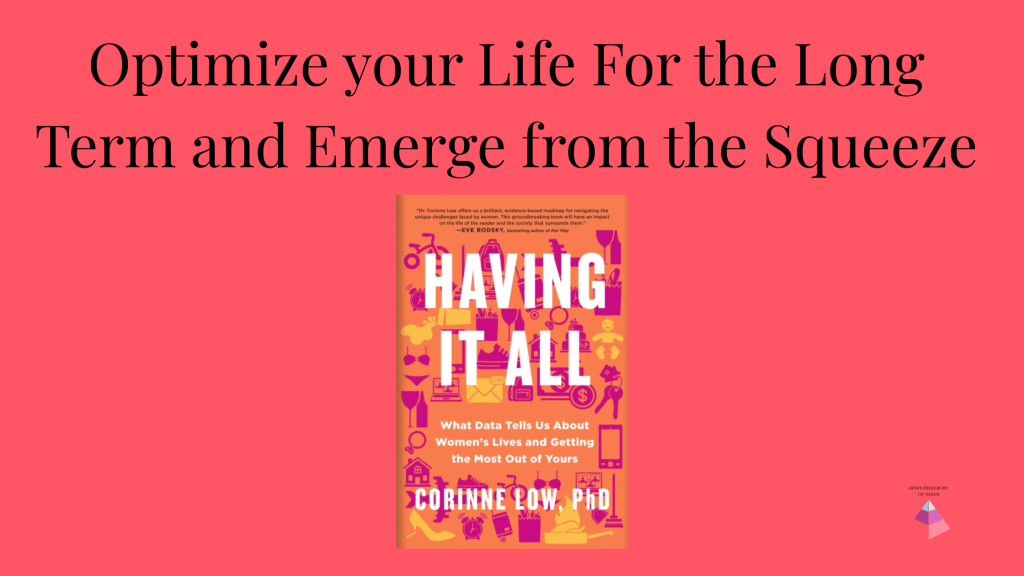
Have you ever fantasized about blowing up your life and resetting everything? Many of us have. Especially when we realize professional growth, raising kids, relationships and self-care, don’t easily fit together. In her new book, “Having it All: What Data Tells Us About Women’s Lives and Getting the Most Out of Yours” Corinne describes it as “the squeeze.”
We’re often forced to invest more in our careers, exactly when our family demands including the costs and complexity, are highest. Most of us are trying to outwit the limitations of our calendars, with some form of schedule-Jenga and hope, but what if there’s another way?
It’s Not You, the Numbers Don’t Work
Corinne said, “Working moms today spend more time than stay at home moms did in the 1970s with our kids.” The combination of modern careers demanding more, in parallel with increased childcare feels untenable. Because it is. In the book, Corinne dives deep into why. And how even when you’re aware of the structural problems, the solutions usually aren’t quick.
Making small iterative changes can ease your burden and increase your joy, but it’s not always enough or fast enough. What will work for you depends on your circumstances. She provides economic frameworks to help you evaluate your options.
But You Can Escape “the Squeeze”
In the book, Corinne explains how to make “level up” moves. The types of changes that dramatically increase your utility function. An economic term she uses to illustrate how some decisions, especially those made under social duress may not align with your highest values or objectives. Knowing what matters most can eliminate a lot of decision fatigue and introduce new opportunities. She presents it in a logical way to help us reorient from the guilt-ridden second-guessing, that’s so common when considering tradeoffs.
Revisit Where You Live
Corinne said, “As I share in the book, I got divorced, moved to Philadelphia and moving to a cheaper city is a huge lever people should consider. Because when people tell me, ‘Oh my God it’s so hard, nothing is adding up financially,’ I’ll say, yes, you live in Manhattan where childcare costs $40,000 a year. That does make it really hard for things to add up.”
Even before the current economic freefall, the pandemic and rise of remote work prompted more families to exit major metros. According to the Washington Examiner, “…Between 2020 and 2024, New York City lost 18% of its population under age 5. Chicago’s Cook County shed 15%. Los Angeles County, 14%. These aren’t marginal shifts, and they represent a wholesale abandonment of urban cores by the demographic cities need most: families with children.”
And Choose How You Live
Your “cost of living” goes well beyond rent, mortgage or taxes. It includes childcare options and commutes because all of it affects your time and quality of life. Corinne said, “one of my proudest achievements with the book is that it caused my agent and editor to move. They said, ‘I’ve created this situation for myself that isn’t adding up because I thought I wanted to give my kids X, Y and Z and I need to change.’ For example, one thought the house in Connecticut with the pool was what success looked like. Then she realized that the hour and a half commute was making her insane. She decided what she actually needs is the apartment in Manhattan, because her kids would rather have her, ‘not be miserable and have the patience to play with them’ at the end of the day.
The book includes other uplevels to consider. Like living near family, investing in different childcare if feasible to increase overall family income and career changes.
Share the Household
In the book, Corinne shares personal revelations behind her major life changes right alongside the data. She said, “Moving to a cheaper city for me was key but I also decided to date women, and I’m now remarried to a woman so, I changed a lot of things. I don’t think everybody needs to divorce their husband to marry a wife, but I do think everybody needs to marry someone who does the laundry. And hopefully that’s something you can find within your relationship. Someone who’s willing to take on that shared work of living.”
For Both Financial and Emotional Benefits
Of course, the gendered household divide isn’t new for moms partnered with dads. In the book, Corinne does a brilliant deep dive on how to assess the economic, leisure and relationship implications. Including thought starters whether you’re partnered, single, considering marriage or a separation. In addition to the practical realities the gendered wage gap has on long-term plans.
Spoiler alert, equitable relationships tend to prosper over uneven ones. So, the benefits are significant. However, it’s among the most difficult changes to make and you may require outside support, like a couple’s therapist or coach.
Look Closely at Your Childcare Set Up
How much childcare and household help you receive, whether it’s paid or unpaid also has a big impact on your daily logistics, career choices and ease. In the book she includes several considerations, whether seeking paid or unpaid childcare options. For example, where you live can change how much oversight your children need. She moved from Manhattan to a more child-friendly area in Philly, with better play dates and schooling options for her son. For example, can your kids play in the yard, versus needing supervision at a playground? Can they walk to school when it’s age-appropriate, instead of you needing to drive them? These factors can change the equation in terms of how your days work. And how aligned your life feels.
Define What Drives Your “Utility Function”
In the book, Corinne shares how she optimized her life in ways that allowed her to reach tenure, as a professor at Wharton which increased long-term career flexibility and financial security for her family. She also shares stories from people who paused or dialed back paid work to increase time spent on personal health or caregiving. When solving for your “utility function” there aren’t right or wrong answers.
Corinne explains, “it’s an economist framework for the things you really value most in life and that’s what you’re optimizing. There’s a lot of stuff on the Internet about trying to have a happier life, as though we’re solving for happiness, but I don’t think that that’s right. It might not feel joyful in the moment to sit by the side of a dying family member and yet that’s one of the most meaningful things we can do with our time. So, what I like about the language of utility is this is what your 85-year-old self would look back on and say, ‘that was a life well lived.’” Bravo!
Many thanks to the talented Dr. Corinne Low PhD!
Get Corinne’s new book, Having it All and learn about her work on her website. Sign up for her newsletter on Substack. Follow her great adventure on Instagram and LinkedIn.
——-
📚 Buy the new book, Repair with Self-Care: Your Guide to the Mom’s Hierarchy of Needs.
 Enjoy the gift of more time for wellbeing and growth. Plus delightful self-care packages for Moms, delivered to your door.
 Ready to put yourself back onto your to-do list? Take a TimeCheck.
 Shared your story yet? Take our quick survey to change how workplaces support parents.
 Employers, become Allies@Work
About Dr. Corinne Low:
Corinne Low is an Associate Professor of Business Economics and Public Policy at the Wharton School of the University of Pennsylvania. Her research focuses on the economics of gender and discrimination and has been published in top journals such as the American Economic Review, Quarterly Journal of Economics, and Journal of Political Economy. She was named one of Poets and Quants 40 MBA Professors under 40 in 2024. Her first book, Having It All, was published in September by Flatiron.
Corinne and her work have also been featured by major popular media outlets, including Forbes, Vanity Fair, The LA Times, and NPR. Corinne is the co-creator of the Incentivized Resume Rating method for measuring hiring discrimination, and regularly speaks to and works with firms looking to improve their hiring and retention practices. She has spoken to and advised firms like Google, IFM Investors, Uber, Activision Blizzard, and Amazon Web Services, in addition to teaching in Wharton’s Executive Education programs. She has given talks to top academic institutions like Harvard University, Stanford University, and Oxford, as well as to organizations like the New York Federal Reserve, Brookings, and the US Department of Labor.
She received her Ph.D. in Economics from Columbia University, her B.S. in Economics and Public Policy from Duke University, and formerly worked for McKinsey and Company. Outside of work, she is the co-founder and volunteer executive director for Open Hearts Initiative, a New York City based non-profit that aims to combat the homelessness crisis through pro-housing neighborhood organizing.