“It’s called caregiving, but the care piece in the real emotional sense, dropped out of it for me. It became more of an obligation and sadly, it’s quite common because most of the time you don’t have a choice. This contributes to the stress and frustration around caregiving that can lead to resentment and guilt. Because most people don’t want to admit, we all want our loved ones to be okay, but we don’t necessarily want 24-hour a day responsibility for it. We still want to live our own lives and it’s a real point of tension,” said Kate Washington, Author, Journalist and Caregiver Advocate.
We enter our partnerships with the expectation of reciprocity, even sanctuary from life’s demands. Few anticipate caring for a spouse before retirement age either. But millions face the sudden need, early in life while caring for their children. Burnout is a risk with any kind of caregiving. Including parenting and that risk only increases with high intensity care needs. Although we can’t predict life’s plot twists, we can learn how to notice the signs of caregiver burnout and seek support to the ease strain.
Few Anticipate Caring for a Spouse Early in Life
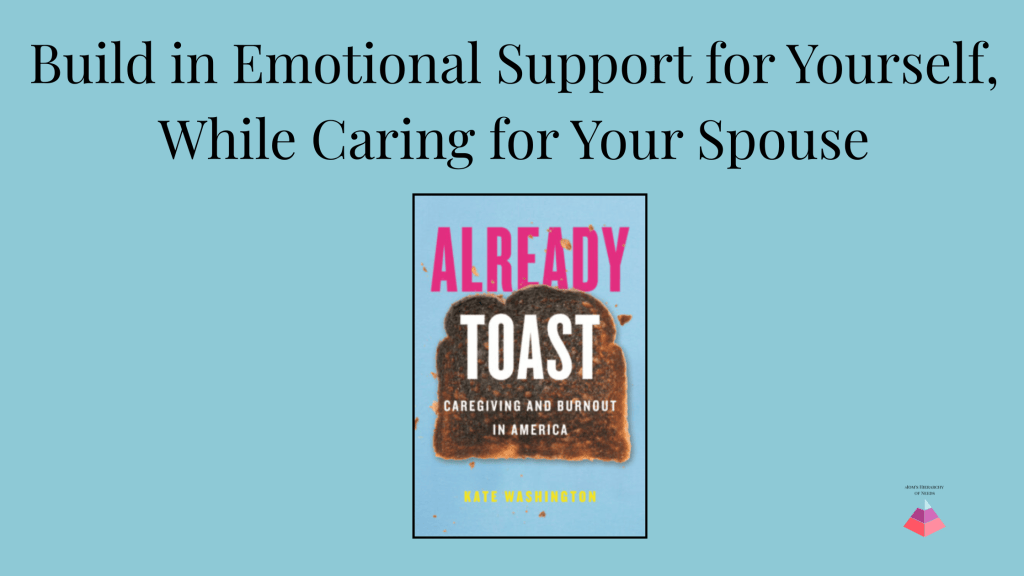
Kate’s youngest had just started kindergarten, when her then husband was diagnosed with an aggressive cancer. He required round-the-clock care as she shared in part one of our interview. “I ended up burning out on the intensity of the care needs combined with parenting. We were surrounded by support, including family help and it was all still too intense. That really became the subject of my first book, Already Toast: Caregiving and Burnout in America. Not just the journey that our family was on with my former husband Brad’s illness. But also the systemic challenges that face caregivers of all kinds, including for the ill, disabled, and elderly in America.”
Millions Provide Hands-On Daily Care
Many care for adults and children with complex medical needs. Kate could not leave her husband alone safely. She quickly learned there was no support infrastructure for families with similar challenges. “Even though that level of care was medically ordered it was not covered by insurance. The landscape varies a little bit by state and if people are eligible for Medicaid there are exceptions. But it’s very difficult to get any kind of support for it.”
Often Without Respite Without Breaks
Caregiver burnout is described by the Cleveland Clinic as, “a state of mental, physical and emotional exhaustion.” Kate said, “Even with two or three home visits a week from a skilled nurse, his care was still so overwhelming, I was spending 35 – 40 hours a week. In addition to round the clock caregivers and family support, because he was so fragile.” Fortunately, they had savings to cover the costs but they had to pay out of pocket.
High-Stakes Caregiving Can Alter a Marriage
Kate said, “Years of this experience really affected the marriage, something that’s not often talked about. It also exposed fault lines that had been there, through normal life and regular parenting. Like challenges we had with conflict resolution. Then we both went through this ordeal that changed us in very different ways. I got so used to over functioning, and then my family was so used to me over functioning, that I didn’t see the inequities until much later.”
The marriage bond comes with unspoken promises and expectations. We hope to provide mutual care over the long-term. But when a partner can’t care for themselves the high-stakes health decisions, appointments, and fatigue of caring for an adult can happen in parallel with raising kids. She added, “Even though my former husband was a very hands-on dad, it was nowhere near fully equitable. And I didn’t realize that really until he was taken out of the equation by his illness. Most of what was added to my plate was just caring for him, not so much household labor. Then, this realization hit, ‘oh I was already doing way more’ so, once he was doing better, I wasn’t really willing to go back to the way things had been.”
Name the Mental Load and Shifts
Kate said, “The term mental load and some of these ideas about what invisible labor looks like were not present 10 to 15 years ago when I started to feel like, ‘wait why am I always the one thinking about the fact that if somebody doesn’t take the baby clothes to Goodwill we’re going to drown in them for the rest of our lives?’ That invisibility of just clearing out the household and keeping it running really hit me.”
The “mental load” and other forms of cognitive labor break even the healthiest among us. It’s also corrosive to long-term relationships and one of the top stressors in marriages. Family caregiving for an adult especially when it’s your spouse, amplifies any existing or new points of friction.
Get Help to Open Communication
Spoiler alert, countless studies show what many of us experience. Most moms partnered with dads, experience the gendered division of childcare and household labor after kids. If your partner is suddenly in need of complex medical care, seek out safe spaces to discuss how that’s changing the relationship, your hopes and what your interim and longer-term needs are. Whether that’s through couples therapy or coaching, a faith community, or using a system like Fair Play to make the invisible work more visible.
Get Emotional Support for Yourself
We discussed how a lot of tasks now performed by caregivers at home, were once in the domain of skilled nursing only. Adding this type of care for a loved one who is ill or disabled, can spark intense worry when the consequences of “doing it wrong” can be catastrophic.
Kate said, “In the case of spousal caregiving, often you’re providing emotional support to the spouse. But the person who was going to be your emotional support through a crisis, is the one who’s needing the support. So, it compounds.”
If you Can, Seek 1:1 Therapy
Kate said, “I did stay in weekly therapy when I was going through the intensity of the caregiving time and that was really critical. I wasn’t doing any deeper healing work, but it was a chance to vent in a safe space. I also know that sadly, it’s not accessible to many people. It can be cost prohibitive, time prohibitive and there are all kinds of reasons why it may not be possible to have that one-on-one support.”
Consider a Support Group for Yourself
Kate explained, “I had close friends who were helpful but I also reached out to online support groups. They’re really good for caregivers, because it is asynchronous and if you’re dealing with a rare disease you can find somebody going through something similar, even if they’re in another part of the world.” Support groups are often free of charge and many are also available in person Ask your care team or doctors, for ideas or recommendations. They may know about groups in your area that cater to the types of needs you and your family are dealing with.
And Resources for Your Kids
Kate’s said, “I was conscious throughout that this was my kids one childhood, and they were also going through something terribly traumatic. So, I tried to provide a lot of support and escape for them to do fun things. I want to shout out Camp Kessem that was an absolute lifesaver for our family and provides free summer camp to children affected by a parent’s cancer.”
She added, “We did end up separating; it’s been several years and now we have an amicable relationship. We still consider ourselves a family, do holidays together and there’s work that goes into maintaining the newly constituted family.”
Reset and Rebuild With Self-Care
Kate recovered from caregiver burnout, the topic of her latest book, in part by reconnecting to her love for wild swimming. When her kids were a little older, and her husband had recovered, she suddenly had more space to consider self-care and fulfillment. Kate said, “I was asked to speak in different places for my first book launch so I thought, ‘when I go on trips, I can jump in the water!’ In Austin Texas, they have a huge spring fed natural swimming pool. So, I went there and anytime I was out of town, I would seek out somewhere to swim. Although I wouldn’t have been able to do that when things were at their most stressful, I could have carved out more time and space and wish I had. It might have prevented me from reaching that level of burnout.”
Many thanks to the talented Kate Washington!
Get Kate’s amazing new book, Midstream: Life Remade in 50 Swims, and her first book, Already Toast: Caregiving and Burnout in America. Follow her great adventure on her website and Instagram.
——-
📚 Buy the new book, Repair with Self-Care: Your Guide to the Mom’s Hierarchy of Needs.
 Enjoy the gift of more time for wellbeing and growth. Plus delightful self-care packages for Moms, delivered to your door.
 Ready to put yourself back onto your to-do list? Take a TimeCheck.
 Shared your story yet? Take our quick survey to change how workplaces support parents.
 Employers, become Allies@Work
About Kate Washington:
Kate Washington is the author of Midstream: A Life Remade in 50 Swims (Beacon Press, 2026)
and Already Toast: Caregiving and Burnout in America (Beacon Press, 2021). She is a frequent
speaker on the systemic challenges facing family caregivers and a longtime freelance writer
whose writing has appeared in The New York Times, TIME, HuffPost, Eater, and many other
publications. She holds a Ph.D. from Stanford University and lives in Sacramento with her two
daughters, one very friendly dog, and one very unfriendly cat. Connect with her at
kawashington.com